Pleasure, Play, and the Freedom to Feel Fully Alive
Aug 05, 2026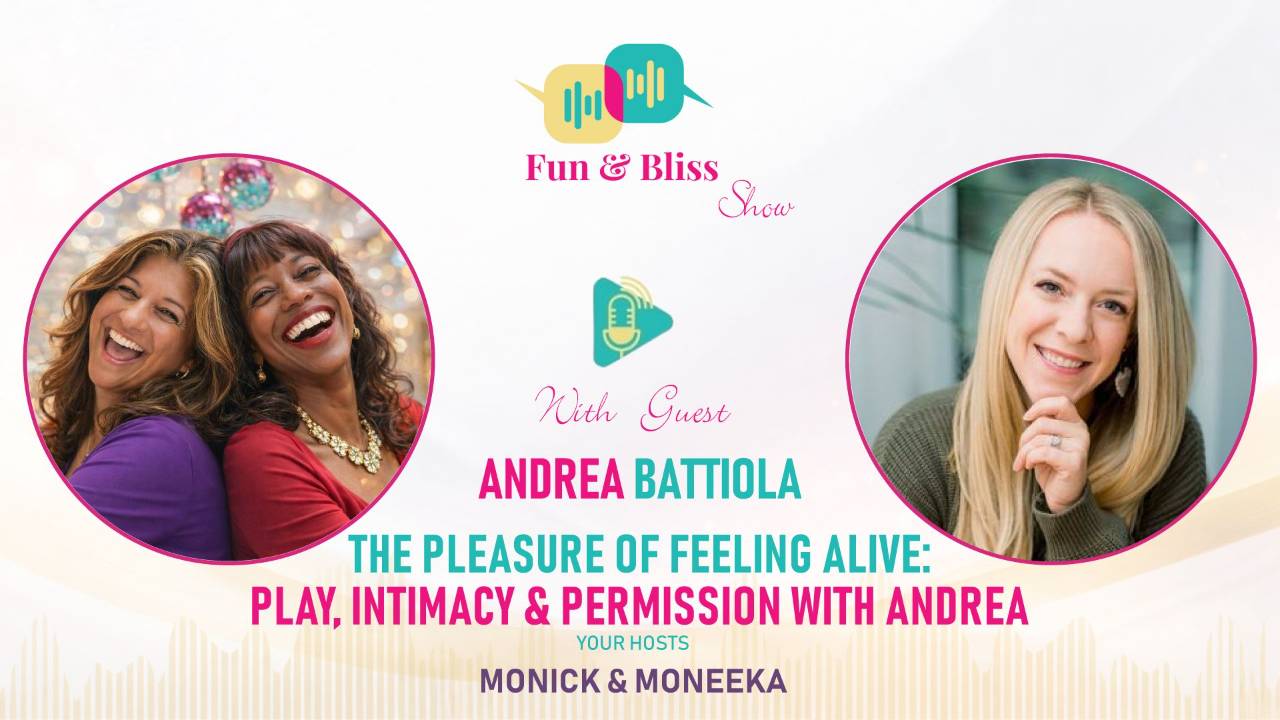
What if pleasure were not something you had to earn, schedule, or save for special occasions, but an essential part of your mental health and everyday life?
In this episode of The Fun & Bliss Show, Monick and Moneeka sit down with couples and sex therapist Andrea Battiola for a refreshing conversation about pleasure, intimacy, playfulness, and what it truly means to feel alive.
Andrea shares why so many high-achieving women become disconnected from their bodies and desires, even while appearing successful in every other area of life. Together, they explore how productivity, performance, guilt, and societal expectations can leave little room for pleasure, and why slowing down, savoring, and paying attention to what feels good can help refill our emotional tanks.
They also discuss the relationship between life inside and outside the bedroom, why couples therapy does not need to be a last resort, and how vulnerability, curiosity, compassion, and laughter can soften shame and deepen connection.
Andrea offers simple, accessible ways to cultivate more pleasure, including exploring your own neighborhood like a tourist, taking an “awe walk,” noticing everyday beauty, creating playful rituals with your partner, and intentionally choosing where to place your attention.
You will discover:
• Why sexual health is an essential part of mental health
• How productivity and performance can disconnect us from pleasure
• Why pleasure is restorative rather than frivolous
• How shame begins to dissolve through empathy, safety, and honest conversation
• Why playfulness outside the bedroom affects intimacy inside the bedroom
• How novelty and shared experiences help couples see new sides of one another
• Simple ways to practice pleasure, presence, and connection every day
• Andrea’s invitation to take a shared awe walk and notice the beauty already around you
This conversation is a beautiful reminder that pleasure is deeply personal, intimacy can be playful, and a more vibrant life can begin with something as simple as slowing down and noticing what brings you alive.
About Andrea Battiola

Andrea Battiola, LPC, LMHC, Ed.S., is a couples and sex therapist, the founder of Peak Couples & Sex Therapy, and the creator of Peak EDU. Since launching Peak in 2016, she has grown the practice into a specialized virtual group of highly skilled clinicians serving clients across Washington, D.C., Virginia, Maryland, and Washington state.
Andrea believes that sexual health is mental health and is passionate about helping individuals and couples create more connected, intimate, and fulfilling relationships. Through therapy, workshops, speaking, and accessible digital education, she helps people move beyond shame, better understand their desires, and build relationships that reflect their values.
At the heart of Andrea’s work is a commitment to pleasure, playfulness, curiosity, and aliveness, both inside and outside the bedroom. She believes that intimacy does not have to feel serious or pressured and that greater connection often begins with permission to slow down, communicate openly, and enjoy life more fully.
Connect with Andrea
Learn more about Andrea Battiola, Peak Couples & Sex Therapy, and Peak EDU:
Website: thepeaktherapy.com
Instagram: @thepeakedu
Email: [email protected]
You can also visit the Peak website to explore The Quiet Pulse, an audio-guided experience, and join The Lounge, Andrea’s weekly newsletter featuring thoughtful insights, relationship and intimacy guidance, and answers to reader questions.
Transcript
Monick (00:02.89)
Andrea, I am so happy you're here with us. when I read about your work and your personal commitment to pleasure and play and aliveness, I immediately felt like such a good, great connection with us. Like our fun and bliss philosophy. And you read our manifesto, so you you know what we're about. And so we're gonna have this really interesting conversation. It's not, I know you're partly you're a couples and sex therapists, but
This isn't a conversation only about sex. It's about feeling alive. Yes. And about connection, curiosity, permission, laughter, intimacy, and the freedom to discover genuinely what feels good for us. Like what feels good each of us individually. And we wanna begin with your story.
Andrea (00:35.63)
Thank you.
Andrea (00:52.714)
Yeah. Well, first off, thank you for having me. I'm very happy to be here. my story as it relates to my professional life, if you want me to start there, I can also start before that. but I well, my professional story starts actually as a freshman in high school. I was walking down the hall from gym class to go to my next class. I don't remember what the next class was, but it kind of just struck me.
walking down the hall that I wanted to be a sex therapist and I had never heard of it. I actually thought I made it up as a profession. and I went to the library and this is going to age me a bit. I asked Jeeves, what why do couples get divorced? And it led me down this path of understanding relationships a bit more and sex being a big part of that.
And so I started pursuing that work from from that point on really. in high school, less so about the the sexual relationship part, but took the like talked to my teachers about it and and what have you and got some guidance on that. But then undergrad and grad school was very much focused on that endeavor.
And I just continued to enjoy it, continued to find it so fascinating. loved sitting in being being able to sit with people in the depths of their lives. as therapists, we get such a a window into the the heart, the mind of our clients. it's
Such a privilege to be able to create that space where people feel comfortable opening up in that way. and around a topic like relationships and sexuality and intimacy, especially. and so I eventually moved to DC and started my own practice there. And now we have a group couples in sex therapy practice called Peak Couples in Sex Therapy. and then I also
Andrea (03:12.662)
recently started a a sub brand that's called Peak EDU, which is for it's kind of like therapy without the therapist, so packaging all of the things that have been really helpful in a therapy setting in a non therapy way. so yeah.
Moneeka (03:32.908)
That's amazing. I know that one of the things that you talk a lot about is mental health and around relationships and sexuality. And that's actually not something that people talk a lot about. When did you realize or was there a particular experience that helped you to realize that you your sexual health is directly related to and an essential part of your mental health?
Andrea (04:01.004)
Yeah. Yeah. It I mean that that that asking Jeeves moment was a big part of that. But then I also I because of my curiosity around it, I ended up being the person that my friends would come to to ask questions and to talk about these things with. And it just became really clear to me that e everyone ha was curious about it. Everyone thought they didn't know anything or that they were doing things wrong or that they were curious about this other thing.
and I just kind of consistently was the the go-to person to be curious with. which I I loved and was like continues to be such a wonderful part of my life today. but yeah, it was that just that consistency of seeing we all are thinking about these things. We're all curious about different versions of intimacy and relationships.
And that no two ever looked the same, right? Like one friend would talk about this part, another friend would talk about something completely different. and so yeah, I think it was just consistently hearing from my peers that they were curious. And that started, yes, in high school, but it it continued on throughout life to today. so yeah, I think that it was just that repetition.
Monick (05:28.118)
You've said that your mission is to help people cultivate more pleasure intimately and otherwise. So when you word pleasure, what does it mean to you beyond the bedroom?
Andrea (05:34.53)
Yeah.
Andrea (05:39.178)
Yes, I do feel strongly about this. it means being able to find joy within yourself and with others just for the sake of joy, not because it's productive, not because it's something you're supposed to do, not because of any other reason, just besides enjoying it. and I think it that's actually like such a challenging thing.
For people today, for a wide variety of reasons, which we certainly can get into. but one I I think it's also important, like one person's version of pleasure can look completely different from another person's. So it's also this element of becoming more and more your full self. and this process of individuation, allowing yourself to be who you are and follow the pursuits that that
make you curious, that make you inspired, that make you feel alive.
Moneeka (06:46.934)
So I love that and I can really relate to that. You know, we often say that every single person listening to this show has their own version of fun and their own version of bliss, right? pleasure is the same way, but I think one of the things we have noticed on this show is that people that have been prioritizing other people or their responsibilities or everybody else's needs, right? Yeah, they lose track.
of what fun might look like for them or bliss might look like for them and what pleasure might look like for them. So we try to kind of pique their interest and their imagination with some ideas of what that might look like by giving examples of our own selves, our own lives and people that we know. Could you give us some ideas on what pleasure how pleasure might show up for a normal person in an ordinary day?
Andrea (07:39.878)
Yeah. I well I yeah, I can get of examples of me in my ordinary days. Yeah. I I feel like I've come around to this even more so in the last maybe like five or six years. but the idea of slowing down in the spaces that you already are and finding joy in them. one way that I do this is I I live in Seattle.
It's a very green place. We are the Emerald City for a good reason. But I walk around my neighborhood probably four or five times a week, often with my favorite latte. And I go really slow. Sometimes I'm with my partner, sometimes I'm alone, but I pay attention to, okay, this this plant looks different than the last last week, or like enjoying the architecture.
There's tons of flowers around here. So smelling them as I go. you know, saying hi to the people that I I pass as I walk by them. and that there's a I didn't realize that there was a name for this. They're called awalks, apparently, the internet says. but it's really, it has been really, really enjoyable to just really peacefully stroll for the sake of strolling.
with a delicious drink in my hand and enjoy all of the beauty that's naturally around me. I also tend to in all of the cities that I've lived, this has been true. but I tend to treat the city that I live in as a tourist a lot as well where I'm very intentionally going to different neighborhoods, walking a down around different areas,
popping into new cafes or new shops, trying out new restaurants, but really s very intentionally spending time in new spaces so that I can get a bit of I I enjoy novelty, so that's part of my pleasure journey, I guess. but very intentionally doing new things that aren't aren't heavy lifts. Like there's no real planning that needs to happen.
Andrea (10:00.344)
There's not a lot of money that's involved in doing that. It's just going to a new place and bopping around. So those are those are two of the smaller, like everyday kind of ways that I very intentionally tried to cultivate pleasure. Not to mention, like if I am eating a delicious meal or a glass of wine, very much slowing down and enjoying all of my senses.
That's something we talk about with intimacy a lot as well. But yes.
Monick (10:33.442)
Savouring.
Andrea (10:34.542)
Savoring.
Moneeka (10:35.662)
Yes, we love that word.
Andrea (10:38.23)
Love a save.
Monick (10:38.862)
So JC. Yes. So I want to talk about a high achieving woman for a moment. So this is a woman who's incredibly capable. Maybe she's managing a career, a business, a family, her home, relationships, very long mental list. And from the outside, everything maybe looks fine, maybe it looks great.
But inside she feels disconnected from her body, her desires, maybe her own sense of fun and play. So why do you think high achieving women can become so disconnected from pleasure, even when they are highly competent in every other area of their lives?
Andrea (11:24.03)
What a good question. yes, it is it and I see this person all the time. This is this is like my client. they, I mean, there's a lot of a lot of elements here, but there's such a pressure to perform. There's such a pressure to not drop any balls. and it's exhausting. It's exhausting to play all these roles, wear all of these hats, to
Perform your best at work, feel the pressure to perform your best as a as a mother, to perform your best as a partner, as a daughter, as a friend in all of these areas. That's so exhausting. It's so depleting. It can simultaneously be rewarding, right? You can still enjoy your job. You can still enjoy being a mother. You can still enjoy all of the roles that you play. But when all of them feel so
vital all the time, like you have to be your best at all of them. It doesn't leave a lot of space for extra, right? It doesn't leave a lot of space for things that
Yeah, things that bring people pleasure. And I often find with my clients that these these people, these women in particular, start to end up feeling like pleasure is frivolous, that pleasure is not productive, and productive being in any of the ways, whether it's like around being a mother or work or what have you. and so it is
kind of dismissed as a necessity, dismissed as a an important way to sustain energy. and it's it's not their fault, right? Like these are messages that are given to us a lot in society that you need to be the best, you need to be the best at everything. You can have it all. If only you keep working, keep putting your head down, keep doing the thing. and so it's like it's very reasonable that
Andrea (13:37.718)
women are struggling with with this. And also I think the lack of pleasure and the lack of enjoyment kind of keeps the cycle going, right? because you're running on E all the time and it's not much is filling up the tank. Pleasure could fill up the tank. Slowing down, savoring could fill up the tank, but it feels like
There's no time, there's no space for it. I'll also add that I find that these sometimes the the reasoning these women have is because there is no time, but often upon digging a little bit deeper with them, it's not about time because there's time for scrolling.
There's time for shows. There's time for more mindless activities. And I don't mean that negatively at all. We can have mindful activities that are replenishing. And then very we need also some mindless activities just to kind of shut off for a while. but there is time for the mindless stuff. and so when I'm working with an individual who's having this experience, we start to kind of uncover that okay, there's time on the
on the clock, there's time in the calendar. how can we give you more permission to use that time for pleasure and your enjoyment without guilt? 'Cause that's a big piece of it too, is that if I'm spending time with myself just for the sake of enjoyment, if I take a long luxurious bath, if I go on a stroll instead of doing the dishes, I'm gonna feel guilty about it. So we work on the guilt as well.
So yeah, I think I think that this is just this is so pervasive, so common. and I I just want to reiterate it's not it's not this woman's fault either, right? There are r very real demands and pressures from society, from her the roles that she plays, that just make it so incredibly challenging.
Moneeka (16:01.814)
I love that you say and remind us that it's not the woman's fault. It's not my fault. It's not your fault. It's kind of the way that we're set up in this society and in many societies, right? in our world, performance is a big word. Right? Productivity productivity and performance are really big words. And
We can turn almost anything into a performance, right? Success is a performance. We can perform being happy. And we can perform in intimacy true too, right? and so when people hear the word sex therapy, there is a part of them that wants to perform. There's nothing wrong with me. There's nothing broken here. There's nothing that needs to be repaired. What do you wish more people understood about what c couples and sex therapy could actually offer them?
Andrea (16:53.194)
Mm, yeah. I I wish that people could see it as something that is not a last-itch effort. that it is it can also be preventative. it can be a support when you're struggling, that it doesn't have to be like you are suffering greatly. and that is your entryway into couples or sex therapy.
that we also there are things that we use in the therapy space that like of course you didn't think of it yourself. Of course your your partner didn't suggest that you do this sensate focus exercise. Why would they? there are things that can be helpful that you just you don't know about until you try it. but yeah I think more than anything
People coming before they feel like it's absolutely necessary that they come, to help them build out what their approach to their relationship and their intimate lives will look like. we, you know, in in life there's a lot there's a lot of things we're not taught about how to how to handle elements of our lives, but especially we
tend to not be taught about how intimacy works and how to communicate about it, how it evolves over time, all of these things. and that's true of the relationship as well. and so, you know, there's and yet we expect kind of perfection around it without ever being taught or practicing or any of those pieces. So
I I wish that people would see it as like, of course, of course you don't know how to evolve in this intimate relationship over 30 years. Why would you? It's you're not doing anything wrong or bad or anything like that because you don't know that. You're just a human. and it's okay to need help.
Monick (19:10.926)
Yeah, so good. So in the area that you you deal with, right? There in terms of intimacy, sexuality, there can be a lot of shame for people around this the subject area, which can make intimacy feel serious, secretive, like very pressure filled. What do you think helps people begin to soften?
Moneeka (19:12.642)
Mm-hmm.
Monick (19:38.924)
the shame and become more curious about what they want.
Andrea (19:42.24)
Yes. this is work done by Brene Brown, who is all about shame and vulnerability. But that's the approach that I often take with couples in intimacy is that if you can start speaking shame, talking about what you're afraid of, talking about the fear of being being unworthy in a safe space, in a space where
with a person who deserves to hear it, right? And that that deserving part is that they've shown you that they're safe. and to be met with understanding and validation and empathy, that is really the antidote to that shame. shame cannot live when there is care and validation and support and empathy. It really can't. and so that is is how
how I work with clients around alleviating some of that shame. and thinking about who you talk to, it's also how you talk to yourself, right? So being the version of yourself in these inner monologues that would support and with empathy and validation and care in a way that you wish someone else would. So it's both internal and in that communication with others.
And it's not overnight, right? That takes a lot of times shame is deeply embedded. It's rooted in messaging received throughout the entire lifetime. it's rooted in traumatic experiences. and so giving yourself permission for that to be a slow process, but one that you kind of slowly practice, I think is important just to manage expectations around
the speed with which shame dissolves. it just takes some time.
Monick (21:44.61)
Yeah.
Moneeka (21:46.326)
I think I love Brene Brown's work and that makes so much sense what you just said. And I think that even when we know what we want, even when we know what we wanna say, even that we know that we're trying to move through our own shame, right? around all this stuff.
Sometimes saying things out loud to someone we love can still feel really vulnerable. we might worry about hurting their feelings or being misunderstood or appearing too selfish or asking too much. I know for me that's a big thing. You're too much, you're too much. I've heard that a lot my whole life, right? so where do couples commonly get stuck when they try to talk about intimacy, desire, and pleasure?
Andrea (22:34.828)
Yeah. Yeah. It you're absolutely right. There can be all of this internal messaging around why you shouldn't do the thing. Because yeah, I'm gonna hurt them. I'm gonna be too much. I'm gonna be asking for too much, so on and so forth. And those can be r I mean, of course, that's it's painful to hold that, and to kind of be bracing for the negative outcome of speaking up. and
Yeah, with couples, I find that yes, the vulnerability is really tends to be a big barrier. So in our couples work, I always meet the couple where they are. sometimes some couples come and they're like, they'll say anything. They'll they're like ready to go. these conversations aren't new for them. and other couples have never talked about this, right? So we go a lot more slowly.
we start with where they are feeling comfortable and start helping them reinforce this idea that by sharing something vulnerable, it's an invitation. It's an invitation into the the inner world of your partner. and to be able to meet that invitation with curiosity and kindness and compassion, that is that is so
important in in starting to be more vulnerable. And then for the person who was feeling fearful of it, in sharing their vulnerability, we check in about, okay, how did that go? Did the scary thing happen? What were you afraid of? Did it happen? and we start to reinforce this idea that it can be a safer space than maybe what it's felt like before.
Now, of course, that takes two people, right? Each person is going to have to participate in doing something different and identifying what prevented them from doing it before. For the per person with who's struggling to be vulnerable, perhaps that was shame. For the person who is on the listening end, if they are struggling to he be kind and compassionate, we need to figure out what that's about. They too are carrying their own.
Andrea (24:59.586)
belief system and messaging and and potentially shame and how is that preventing them from being able to open up about pleasure or intimacy and so we really you know my work as a couples therapist the relationship is my client one person isn't it's it's them and the relationship so it's really being able to hold space and create this safe container for each person
as we kind of move slowly to that more vulnerable place of talking about the issue, their wants, their likes, their desires, their hopes, their dreams, all of all of that.
Monick (25:41.132)
Love that. So I know that playfulness is a really important thing to be able to have in a relationship. How how would you say couples can create more playfulness without turning play into an assignment or goal or expectation?
Andrea (26:00.326)
Mm. Yeah. I I love talking about playfulness with couples because I think the model that we are often given about intimacy is that it's like brooding, it's very serious. and that works for some people and that's great, and it does not work for other people. and so instilling a bit more playfulness together is is really helpful to just kind of take the the
the pressure down a bit. it gives each person an opportunity to maybe be silly or have some levity. it also brings us back to like
a more inner place, right? I think for a lot of people it's it's a deeper access to what's inside than just the exterior. And that's tends to be what we want when we're being close with our partner, intimately or otherwise. and so I think couples being playful without demand is r is really important.
and yes, trying to trying your best to not turn that into like a prescription. we want it to be thoughtful and intentional, but not prescriptive. that that kind of inevitably turns it back into something that is no longer enjoyable or no longer playful. so I think
If you feel comfortable talking with your partner about that, I think having regular check-ins about how is this going? Does it feel does it feel light? Does it feel playful? are we getting a bit prescriptive about it? How can we make that different? Really allowing each other to be your teammate in it, to the best of your abilities. I know that's not always easy, of course. but
Andrea (28:16.374)
Seeing your partner as yeah, as your teammate in this. You don't have to figure it out alone.
Monick (28:24.834)
Yeah.
Moneeka (28:26.482)
So I we on this show we talk a lot about blisciplines, right? And playfulness is one of those blisciplines, right? This is where your work kind of overlaps really beautifully with sort of the fun and bliss philosophy. and I have often said that how we do anything is how we do everything. And I think so many people think that the way that they are
outside the bedroom is completely different. It's a different universe than what's going on inside the bedroom, right? Yeah. but how playful you are outside the bedroom is also it transfers, right? If you have a really serious, you know, melancholic, broody relationship, it's gonna be hard to be on fire and playful in the bedroom. And the other way around, if you're feeling a lot of shame in the bedroom,
it's gonna be hard to be playful and joyful and delightful with one another too outside of the bedroom, right? So they really do affect one another. Right. So could you talk a little bit more about that, that piece of, you know, how everyday life containing more laughter, novelty and adventure and play, how that translates into the bedroom.
Andrea (29:40.214)
Yeah. Yeah. I was actually thinking about this earlier today and thinking about the specifically the the person, woman or anybody who is really is is wanting a more playful, more pleasurable, intimate life. and when they when they come to see me, we we first of course assess for
Is this about pain? Is this about depression or anxiety or what have you? Is there is is there some kind of other factor playing a role here? But I also explore their life broadly. I get to know them as a person holistically. and inevitably I would say that the vast majority of the time, as I'm i I'm starting to learn about what their day-to-day life looks like, what their the hats they wear are, it is
a person with a lot of stress, a lot of roles that they play. They may have their own business. They may be in a very stressful work environment. They have they're a parent, they're whatever. and so they're coming to see me and saying, like, I want a better intimate life. I want to feel more pleasure. I wanted to be nicer. And then I look at the rest of their life and they're like they're so depleted. They're so exhausted. They're so
like rung dry of joy. And we start to have the conversation around, it's going to be really hard to go from that, the day-to-day life where you feel so kind of empty sometimes, to total freedom. Just total opening up, the ease that's required for that kind of playful
experience intimately. And so our work becomes yes, about the the sex therapy specific pieces that we may need to the interventions that we may need to use, but it also becomes about how is life structured more broadly. Because of course, like why why would you be able to flip a switch into play and levity when you have all of this weight?
Andrea (32:08.622)
That you're carrying because the the the backpack of weight didn't get dropped off before you entered the bedroom, right? It's still on. It's just or it's just like right there on the bed waiting for you when you're done. So you know that. And it's so, anyways, it's it ends up being very much tied together. What life looks like outside the bedroom plays a role with life inside the bedroom. and
Sometimes switching things in the bedroom means switching things outside of the bedroom where you have control, right? Because a lot of those things you may not have control over. but there may be things that maybe don't need to be as important, some balls that you could drop because they won't break. and yeah, allowing, I think allowing more joy and pleasure outside.
Of the bedroom so that there's a more familiarity with it when you're in the bedroom. And I just to add to, I find my role often ends up being granting permission that it's okay for you to do that. It's okay to switch these things around. the people often know that they're not necessarily linking it with the bedroom, but they often know like this is not sustainable.
I don't like this. Something's gotta give here. And often my role is just saying, yeah, yeah, you're right. That those can change. How do we do that? Let's work on that together. so you can feel a bit more freedom.
Monick (33:55.994)
You you talked earlier, you know, exploring Seattle like a tourist, taking these long awalks and then I
Andrea (33:58.542)
About
Andrea (34:07.48)
Yeah.
Moneeka (34:09.164)
I love that by the way.
Monick (34:10.893)
I'm gonna totally sell. And every year you and your partner spend a month living and working in Latin America. And I love I love this because it's such a good reminder that real aliveness comes from looking outside of yourself and like seeing the world in a new way or seeing new things. What have those experiences taught you about novelty, partnership, and staying alive to one another?
Andrea (34:18.784)
Yeah. And
Andrea (34:38.86)
Hmm, yeah, that's a nice question. yes, we'll well, I would say that every time we are able to see I brought up novelty earlier. We are able to see new parts of each other. whether it's overcoming a challenge that comes with being longer term in another country or
getting to an Airbnb that's really terrible and having to figure that out. so we we see the novelty in that, but we also see the novelty in being able to, you know, look at this beautiful cathedral with like bright big eyes, or having a conversation with someone at a cafe and seeing our partner light up with this this new interaction.
I think when we are doing these trips, we both allow certain parts of ourselves to come out a bit more. like the the term that I was using over this last trip was vibrancy and effervescence. both of those were things that we were not feeling on this most recent trip and recognizing how much that means to us to access that parts of that part of ourselves.
It looks different for me than it does for him, but we both enjoy that feeling. And so on these on these trips, we are we're working, so we are holding pretty normal hours work-wise. But we very intentionally in the mornings and in the evenings and on the weekends go out and try to just be a part of the community that we're in, meet people, experience something new, see new sites.
and it really allows us to connect with ourselves, but also each other more in that way.
Moneeka (36:45.688)
So Monique and I love to travel. We're both big travel buffs. my husband and I have been to 72 countries. I'm one of those people that counts. and not many people do that. I don't know why. We're not competitive about it. We just like counting. and they've all been for fun. It's not like I don't count the ones where we're there for business or whatever. But we've we lived in France for a year and a half. anyway, so we travel and being in other places. Part of what we love so much about that is that.
Andrea (36:59.404)
I love that.
Moneeka (37:15.336)
Eye opening that the every time you turn a corner, there's something that inspires curiosity or awe. And I do think that we lose a lot of that at home. And so we can interject that, right? Through travel, or for me, sometimes it's a trip to the zoo and just watching the animals or things like that, right? Like there are ways that we can interject it into our lives on a regular basis. But
For for us, bliss and fun, fun and bliss, our intention is that people are able to experience it in the moment, every moment. Like not every moment is gonna be blissful and fun. Sure. That's true. But as much as we can in our daily lives without having to go to South America or to France or you know, somewhere or whatever. and so people often think of bliss as grand and fun as as
you know, something that they have to go out and do all the time. But that's not really the truth in my my point of view. So talk to me a little bit about what you what does living a blissful life really mean to you in everyday terms.
Andrea (38:27.278)
Yeah. Yeah, I completely agree. Right. Like the it is such a privilege to be able to travel and go on these trips. And you know, whether that's financially or like our work s situations that allow us to do that. and that's not accessible for everybody. but that doesn't mean that you can't experience a day to day fun and blissful life.
I think it's really about your mindset, right? How you at any given time, there are so many things we can pay attention to. There are so many stimuli. Right now, there's a ton of trees in front of me. I get the windows open. I can hear things outside. There's a ton in my office here. I could be paying attention to any of those things. There's a there's thoughts in my head, in my feelings in my body. I could pay attention to any of those things.
And we often don't realize that we have a choice over what we pay attention to. and so and that's a practice, right? That doesn't happen automatically. It's a a practice of getting better and better at paying attention to the things that serve you, right? If I'm having this conversation with you both and I'm just listening to what's happening outside, that's not serving me. That's not serving anybody. So I'm choosing to pay attention to this conversation.
And I think that goes for pleasure. We can choose to pay attention to the annoyances, the hardships, the irritations, those things. But we can also choose to pay attention to the fun, the pleasure, the bliss, the joy, all of that. And so I think one may be accessible.
tool to live a blissful life is slowly starting to practice. What am I paying attention to? Where is my focus going? Because I get to have a say in that. Right. And that can happen just, yeah, as you're sitting in a meeting. What do you choose to pay attention to in this meeting? As you're having your lunch, what are you choosing to pay attention to? Building up your own sense of confidence around the fact that you get to have a say.
Andrea (40:49.472)
in what you pay attention to is really important.
Moneeka (40:54.272)
I love that. I I love it when people will say to me, you know, well, you can't, how can you be bl so blissful when there's these things happening? And I'll say, yes, but there's also these things happening. And they'll say, Yes, but the truth is. Right. People are talking about the truth is. And the reality is that what they're seeing is truth and what I'm seeing is truth. Right. It's just which truth are we focusing on. Right.
Right. And I love the way you just said that so beautifully and so gently that your truth doesn't have to be the same as everybody else's. You do have options. Yeah.
Andrea (41:33.182)
Yeah. Yeah, absolutely. And I, you know, it's it's also okay if you need to focus on the things that are not so fun and blissful sometimes too, because that is part of life. And then also there are likely a lot of times where there's opportunity to tune into something else.
Moneeka (41:53.735)
Absolutely.
Monick (41:55.264)
Yeah. So we talk about on this show blisciplines. So those are our habits, rituals, ways of being that help us feel lighter, more vibrant, more connected, help us feel blissful, right? What are what are some of your blisciplines?
Andrea (42:09.346)
Yeah.
Andrea (42:16.296)
Yes. I would say that those awe walks are part of my blisciplines. I s often I have the privilege of living in a place where there's a lot of natural beauty. so there's a lot of water, there's a lot of mountains, and so I am very intentional about going and just sitting in front of them. just soaking it up, not
Not trying to achieve anything necessarily, but just I enjoy looking at water. I enjoy looking at mountains. So I I do that very regularly, multiple times a week, typically. am
I don't love the term foodie, but I guess I I do really enjoy food. And so I very intentionally will get a delicious meal regularly, with a good wine pairing because I enjoy that. I connect stay connected to a lot of a lot of my I'm not from Seattle, so a lot of my friends and family are all over the country, and I very intentionally stay connected to them.
My three best friends live in Minneapolis and we send what we call Wednesday waffles to each other, which is just a two-minute video of checking in about our lives. and both both making the video and receiving them is incredibly enjoyable. yeah, I I think there's a lot of other smaller ones, but I'll start with those.
Monick (43:55.726)
Mm-hmm.
Moneeka (43:57.152)
Yeah, I love that too. That's one of the things that I love about this show is we pick up all these really cool things that we can add into our lives. Yes.
Andrea (44:05.486)
This is this is actually a fun one that my husband and I started doing recently. We tend to be very playful and silly and weird together. and every night before bed we put lotion art on our hands. And so we started considering it lotion art. And so every night I put like a lotion thing on my hand. He does it on his hand, and then we each have to guess what the other drawing is. What is the art? What are we seeing here?
And it's quite delightful, I will say. Very fun.
Moneeka (44:40.59)
I love that. You know, you so we're talking about your balisciplines. In each show, we like to give our listeners a little something, nothing like a complete overhaul, nothing, you know, not like something complicated, but something small, an experiment that they can try this week. so do you have something that our listeners who want more pleasure and connection can try as an experiment this week?
Andrea (45:07.744)
Yeah, I I think a fun one would be to go around the neighborhood that you already live in, a place that you already know. That's not you're not having to like drive to a whole new area, what have you, and go on a walk with your partner and point out things that you're noticing that you're enjoying, right? That flower is really beautiful, let's go smell it. I love the new, you know.
Patio chairs they put out on their deck. the the birds sound so pretty right now, whatever it is. But go and enjoy that. That's a type of intimacy is being able to enjoy beauty together and being able to identify for yourself beauty in the mundane. and so just going on a simple could be 10 minutes. It doesn't have to be long, but.
Doing so with your partner if you have one. If you don't have one, do it with yourself. That sounds lovely. and just acknowledging the beauty that's around you.
Monick (46:13.998)
Shared awe walk. Yes. Yeah. So great. All right. So now it's time for our fun and bliss laser round. So these are quick playful questions. No need to overthink anything. Just have a first answer that feels true for you. So what's your go-to when you need an instant joy boost?
Moneeka (46:15.0)
Let's
Andrea (46:35.2)
Mm.
Pictures and videos of my niece and nephew.
Moneeka (46:43.763)
Nice. And what's one thing that never fails to make you laugh?
Andrea (46:49.56)
Physical comedy. For some reason it's just it gets me.
Moneeka (46:51.628)
Mm-hmm.
Monick (46:55.118)
What do you do for fun these days?
Andrea (46:59.346)
I go on the water. I host a lot of friends in town. I've been thoroughly enjoying World Cup content. so fun. and a really good wine.
Moneeka (47:17.614)
Wine's been a recurring theme for you.
Andrea (47:20.95)
Yeah, I'd love it. I live in Washing Washington State is the second biggest producer of wine, so comes naturally.
Moneeka (47:27.254)
It's amazing. I love that. My little sister actually lives in Seattle too and she is full on all about the wines.
Andrea (47:34.688)
It's it's like it's everywhere here, so yeah. It's natural.
Moneeka (47:39.256)
That's awesome. Okay. Finish the sentence. Bliss for me looks like
Andrea (47:48.302)
Bliss for me looks like a sense of calm and peace in my body and my heart and in my mind.
Moneeka (47:56.622)
Mm-hmm.
Andrea (47:58.958)
Yeah, yeah.
Monick (47:59.97)
Yeah. Blissful. All right. Well, thank you so much. We're gonna go go a little deeper in our in in our bonus conversation. So y'all, you can join us in the Fun and Bliss collective to hear that. I'm thinking we know we've we've spoken a lot about pleasure, especially outside the bedroom. I'm thinking maybe we can go and talk a little bit more about pleasure in the bedroom. and get a you know, get a little bit more into that conversation.
but you know, definitely join us there. But before we go, what's the best way for people to connect with you or find out more about what you do?
Andrea (48:39.048)
Yeah. people can visit our website, thepeak therapy.com. you can also access peakedu through that link as well. There's a separate tab for peaked you. we're on Instagram at the peakedu. and people can reach out on any of those platforms.
Moneeka (49:04.768)
And do you happen to have a free gift or a resource or an event that you'd like to share with our audience?
Andrea (49:10.804)
Yes, I have The Quiet Pulse is one of our peak EDU offerings and people can go on the site and download it. it's a an audio guided experience. and as well, people can sign up for the lounge where I send a weekly newsletter that's relationship or intimacy focused. they include
kind of like editorial style writing as well as QA. So people can send in questions. I love to read them. I love to answer them. and then I include those in the newsletter as well.
Monick (49:53.374)
Amazing. And thank you so much. And if you're listening, you can go to funandbliss.com and under the this episode you will be able to find those links there. all right. So thanks. And we are going to can continue this conversation in the fun and bliss collective. Deeper content.
Andrea (50:04.451)
Mm-hmm.
Andrea (50:15.106)
Amazing. Thank you.
Ready for more fun, connection, and aliveness in your everyday life?
Come join the Fun & Bliss Collective, a joyful community of women choosing to stop postponing joy and start making fun a regular part of life.
Join the Fun & Bliss Collective and find out more
